

11. Multi-criteria Suitability Analysis#
11.1. Plan for the Rest of Semester#
Suitability analysis
Point pattern analysis
Spatial autocorrelation
Note: Won’t cover spatial interpolation
No lab 12 (focus on final project instead)
11.2. Multi-Criteria Evaluation (MCE)#
Evaluate a number of alternatives based on a set of criteria (factors)
Calculate criterion/factor scores for each alternative
Score standardization (e.g., 1 to 10 points)
Combine factors
Adding factor scores
Applying factor weights (relative importance of the factors)
Rank alternatives based on the combined scores
11.3. Spatial MCE (Suitability Analysis)#
Rank sites/locations with a set of criteria/factors
Alternatives:
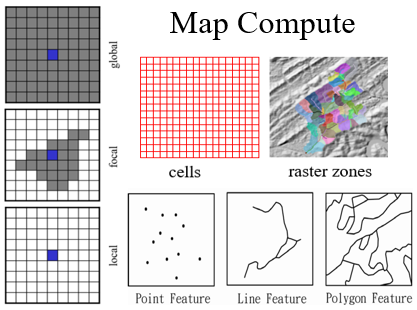
Features (points, lines and polygons in the vector data model)
Cells (raster data model)
11.4. Siting a New School Example#
A small town in Vermont has experienced a substantial increase in population
A new school must be built to take the pressure off existing schools
Task: Find potential sites as a GIS analyst
11.5. Potential School Site Criteria#
Factor 1: Land use
Avoid steep slopes and wetlands
Preferred land use types: open land, forest, or pasture
Factor 2: Proximity to existing schools
Not too close to existing schools
Factor 3: Proximity to recreational facilities
Close to parks or existing recreational facilities
11.6. Suitability Analysis Procedure#
Determine factors and constraints
Derive factor maps
Standardize factor scores (Reclassify)
Determine factor weights
Combine factors (Weighted sum)
Choose the best sites
11.7. Step 1: Factors and Constraints#
Factors: Criteria that define the degree of suitability (e.g., distance to parks)
Constraints: Criteria that limit the alternatives (e.g., excluding wetlands or existing urban areas)
Binary: 1 (suitable) or 0 (not suitable)
11.8. Step 2: Derive Factor Maps#
Distance to schools (Euclidean distance global operation)
Distance to recreation sites (Euclidean distance global operation)
Slope (Focal operation from DEM)
Land use (Input categorical map)
11.9. Step 3: Standardize Factor Scores#
Factors are measured in different units (meters, degrees, categories)
Reclassify them into a common scale (e.g., 1 to 10)
High score = More suitable
Low score = Less suitable
11.10. Standardizing Distance to Schools#
Goal: Sites should be further away from existing schools
0 - 1000m: 1 (least suitable)
1000 - 2000m: 3
2000 - 3000m: 6
3000 - 4000m: 10 (most suitable)
11.11. Standardizing Land Use#
Forest: 10
Pasture: 5
Water: 0 (Constraint)
Urban: 0 (Constraint)
11.12. Step 4 & 5: Combine Factors#
Simple Addition (Equal weights)
\(Total Score = Factor1 + Factor2 + Factor3 + Factor4\)
Weighted Linear Combination (WLC)
\(Total Score = \sum (Weight_i \times Score_i)\)
Sum of weights must equal 1.0
11.13. Calculation Example#
Factors: Landuse (0.3), Recreation (0.3), School (0.2), Slope (0.2)
Factor scores at a cell: 10, 10, 2, 5
Calculation: \(0.3(10) + 0.3(10) + 0.2(2) + 0.2(5) = 7.4\)
Compared to simple average: \(27 / 4 = 6.75\)
11.14. Analytic Hierarchy Process (AHP)#
Used to determine factor weights when it is difficult to assign numbers directly
Organizes factors into a tree structure
Decomposes complex decisions into simpler comparisons
Derives weights by comparing the relative importance between two factors at a time
11.15. AHP Factor Weights Determination#
Factor relative importance through pairwise comparison using a 9-point scale:
1: Equally important
3: Moderately more important
5: Strongly more important
7: Very strongly more important
9: Extremely more important
The best weights are calculated to fit into a pairwise comparison matrix
11.16. Summary of Suitability Analysis#
Suitability analysis identifies the best locations based on multiple geographical factors
Requires standardization of diverse data types into a unified scoring system
Weighted combinations allow analysts to prioritize certain factors over others
The final output is a suitability map where higher values indicate better alternatives