

1. Geospatial Data#
1.1. Topics#
Geospatial data
Measurement and reference systems
Mapping and measurement frameworks
Map as stored function
Types of maps
1.2. Geospatial/Geographic Data#
Data about things on or close to the Earth’s surface
Terminology: Spatial, geospatial, or geographic data
Scale: Operates at an Earth or planet scale
Spatial location
Spatial > geospatial
Geospatial = geographical
Three components
Attribute (what)
Location (where)
Time (when)
1.3. Why Do We Need Geospatial Data?#
Life is spatial
Life itself (matter) takes up space
It distinguishes itself from its environment
It interacts with the environment
It lives in space
Spatial intelligence
One of Howard Gardner’s multiple intelligences
Involves immediate sensory perception
Geographical intelligence
Insight beyond the line-of-sight
Insight beyond sensory perception
[Image of Howard Gardner’s multiple intelligences theory]
1.4. Life and Information#
What is life?
The basis of life is information processing
Life collects, stores, and uses information
Applies to biological and artificial life, organizations, and the economy
What is information?
Something that allows an observer to make predictions about the state of another system that are better than chance
Information vs. Data
Data becomes information when it enables better-than-chance predictions about another system
1.5. Measurement and Reference Systems#
Measurement
Classical physicist perspective: Provides a numerical relationship between a standard object and the object being measured
Representationalists perspective: Assignment of numbers to objects according to certain rules
Useful data includes both the numbers and the standard objects or rules used
Measurement reference systems
A set of rules for measurement or standard objects
Provides a means to compare a particular number to others measured under the same set of rules
1.6. Measurement Reference Systems#
Reference systems exist for attribute, time, and space
Temporal reference systems
Local vs. global time
Gregorian vs. lunar calendars
Attribute reference systems
Units (standard objects)
Levels of measurement: Nominal, Ordinal, Interval, and Ratio
Running race example
A number to wear (Nominal)
The order of finishing the race (Ordinal)
Arrival time (Interval)
Elapsed running time (Ratio)
Su |
Mo |
Tu |
We |
Th |
Fr |
Sa |
|---|---|---|---|---|---|---|
31 |
1 |
2 |
3 |
4 |
5 |
6 |
7 |
8 |
9 |
10 |
11 |
12 |
13 |
14 |
15 |
16 |
17 |
18 |
19 |
20 |
21 |
22 |
23 |
24 |
25 |
26 |
27 |
28 |
29 |
30 |
31 |
1 |
2 |
3 |
1.7. Spatial Reference Systems#
Location distinguishes geospatial data from other types of data
Specifying location on the Earth’s surface is essential
Geospatial coordinate systems are designed to:
Define locations on or close to the Earth’s irregular curved surface
Ensure each location is uniquely represented
Allow calculations of relationships such as distance and direction
1.8. Geographic Coordinate Systems (GCS)#
Based on a spheroid model of the Earth
Uses two angular measurements (latitude and longitude) to specify a location
Components of a GCS:
Geographic Coordinate System |
|---|
Datum (Sphere or Ellipsoid) |
Unit of Measure (DMS, DD, or Radian) |
Prime Meridian |
[Image of geographic coordinate system latitude and longitude]
1.9. (Horizontal) Datum#
A datum specifies a sphere or ellipsoid used to approximate the Earth’s shape and size
It defines how that model is aligned with the Earth
Latitude and longitude are defined based on specific datums
The same location may have different coordinates depending on the datum used
Earth-centered (WGS84) datum
Local (NAD27) datum
1.10. Projected Coordinate Systems (PCS)#
A PCS consists of:
Projected Coordinate System |
|---|
A linear unit of measure (usually meters or feet) |
A map projection with specific parameters |
An underlying Geographic Coordinate System |
1.11. GCS vs. PCS#
PCS is suitable for small areas
PCS always contains some form of distortion
GCS calculations for distance and area are more accurate but more complex
Uses spherical geometry
Most GIS analytical functions are implemented based on PCS
Use PCS primarily for printing or display on flat media
1.12. Height and Vertical Datum#
The vertical datum is the zero surface to which elevation refers
Geoids (equipotential surfaces) are standard zero surfaces
Ellipsoids can also be used, such as in GPS readings
The same location may have different elevation values based on different vertical datums
1.13. Mapping—Creating Geographic Data#
The process involves turning things on or near the Earth’s surface into data
Representing reality as numbers in a computer
What is measured:
Objects and fields on or close to the Earth’s surface
Location, attribute, and time components
Considerations and constraints:
Purpose and resources/cost
Resolution and precision
Limitations of finite computing systems
1.14. Mapping and Measurement Frameworks#
Geospatial data consists of location, attribute, and time components
All three components cannot be measured simultaneously
Measurement frameworks provide rules for ignoring or controlling some components to measure one
One component must be fixed (irrelevant)
Another component serves as control (imposes discrete divisions)
Discrete divisions constrain the resolution and accuracy of the measurement
1.15. Common Mapping Measurement Frameworks#
Time is fixed: Measured at a specific point in time or during a period
Location as control: Space is divided into cells, polygons, or administrative boundaries
Attributes are then measured for these divisions
Attribute as control: Specific attributes (e.g., land cover types or elevations) are chosen
Locations are then measured for these attributes
1.16. Mapping Surface Elevation—Raster Map#
Location serves as the control
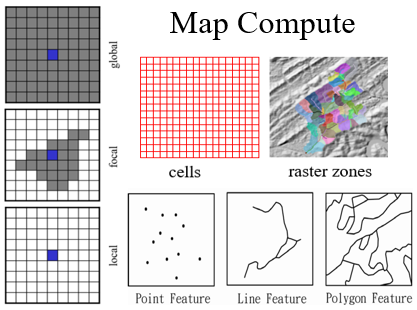
Space is systematically divided into cells
Attributes are measured at each cell
Rules like min, max, or mean may be applied
Cell values are typically stored as a matrix
1.17. Mapping Surface Elevation—Vector Map#
Attribute serves as the control
Focuses on discrete elevations (e.g., every 100m)
Locations are measured for each elevation (e.g., contour lines)
Location-value pairs are stored as rows in a table
ID |
Location/Geometry |
Elevation |
|---|---|---|
1 |
(x1,y1), (x2,y2) … (xn, yn) |
100 |
2 |
(x1,y1), (x2,y2) … (xm, ym) |
200 |
10 |
(x1,y1), (x2,y2) … (xk, yk) |
1000 |
1.18. Vector Census Map#
Location serves as the control
Uses census blocks or aggregated boundaries
Population is counted based on set rules
1.19. Function and Map#
A function associates each element x of a domain to a single element y of a codomain
Analogy for maps: Location represents the domain, and the measured attribute represents the codomain
1.20. Stored Function#
Relations are explicitly stored when they cannot be represented mathematically
A stored function acts as a lookup table
Locations must be discretized (mapping units) due to finite computing power
1.21. Map as Stored Function#
Relation between location and attribute: \(Attribute = f(location)\)
Domain: Location on Earth
Codomain: Any measured attributes/variables
Map is a stored function because location-value relations usually lack mathematical formulas
1.22. Raster Map#
Matrix serves as a stored function
Each cell is located by its row and column
Each cell represents a location-value relation
Usually, the upper-left corner cell is georeferenced; other locations are derived
1.23. Zone Raster Map#
Cells with the same value form a “zone”
The zone serves as the mapping unit location
Typically includes an attribute table with counts/histograms
Zone ID |
Count |
Value |
|---|---|---|
0 |
50 |
200 |
1 |
50 |
325.6 |
1.24. Predicting Attribute Value at a Location#
Map as a function: Prediction is a fundamental capability (\(v = m(l)\))
Estimation/Interpolation is necessary when the target mapping unit differs from stored units
1.25. Interpolating Attribute Value#
Land cover interpolation: Uses majority types for target polygons
Population interpolation: Uses areal interpolation
Attribute types:
Intensive: Magnitude independent of size (e.g., density)
Extensive: Magnitude is additive (e.g., mass, population)
Spatially intensive: Value is the same everywhere within a mapping unit
Spatially extensive: Value changes if the mapping unit is modified
1.26. Multi-valued Vector Map#
Results from combining multiple single-valued maps (e.g., Soil + Land Cover)
Each mapping unit represents a set of homogeneous attributes
Map |
Attributes |
|---|---|
Soil |
A, B |
Land cover |
C, D |
Combined |
(A, C), (A, D), (B, C), (B, D) |
1.27. Multi-Valued Raster#
Each cell contains a set of attribute values (e.g., multi-band remote sensing)
Storage methods: Band sequential (BSQ), Band interleaved by line (BIL), and Band interleaved by pixel (BIP)
1.28. Meta-map: Map of Spatial Relationships#
Spatial relationship involves the exchange of matter, energy, and information between locations
Examples include watersheds and viewsheds
Types of map relations:
Single-valued: {Location, value}
Multi-valued: {Location, {values}}
Meta-map: {Location, {(location, {values})}} (a map of maps)
1.29. Flood Inundation Relations#
Floodplain pixels (FPP) can be flooded by flood source pixels (FSP) through backfill and spillover
Depth to flood (DTF): The minimum depth at an FSP required to flood a specific FPP
The FLDPLN model identifies these relations and DTFs through an iterative process