

13. Point Pattern Analysis: Clusters#
Topics:
Mapping point clusters
Clustering points
13.1. Point Randomness#
Characterizing the overall point pattern (randomness):
Random
Uniform (Dispersed)
Clustered
13.2. Locate Clusters#
Knowing that a point distribution is clustered does not necessarily give information about where the clusters reside.
Mapping clusters:
Calculate spatial variation of point density.
Useful if points are samples.
Clustering points:
Identify specific points that are close to each other.
Useful if points are the “population.”
13.3. Mapping Clusters (Kernel Estimation)#
Areas of high point density indicate clusters.
Naïve point density mapping:
Use a regular grid in space.
Calculate the density of points within a circular neighborhood at each grid center.
\(Density = Number\ of\ points / \pi d^2\)
13.4. Kernel Density Estimation (KDE)#
A focal operation where weights are defined by a continuous kernel function.
The weight is highest at the center (focus) and decreases to zero at the neighborhood boundary (bandwidth).
Provides a smoother surface than naïve density mapping.
13.5. Issues with KDE#
Choice of bandwidth (radius) significantly impacts the result.
Small bandwidth: Shows local variation and noise.
Large bandwidth: Shows broad trends but hides local clusters.
Choice of kernel function (e.g., Quartic, Gaussian) has less impact than bandwidth.
13.6. Clustering Points#
Grouping points into categories based on spatial proximity.
Goal: Find groups of points that are “closer” to each other than to points outside the group.
13.7. K-Means Clustering#
Partitions \(n\) points into \(k\) clusters.
Procedure:
Randomly select \(k\) points as initial cluster centers (centroids).
Assign each point to the nearest centroid.
Re-calculate the centroids of the new clusters.
Repeat steps 2 and 3 until centroids no longer move significantly.
Issue: You must specify the number of clusters (\(k\)) in advance.
13.8. Density-Based Spatial Clustering (DBSCAN)#
Classifies points into three categories:
Cores: Points inside a cluster with at least \(m-1\) points within distance \(r\).
Borders: Points inside a cluster but with fewer than \(m-1\) points within distance \(r\).
Noise: Points not belonging to any cluster.
Does not require specifying the number of clusters in advance.
Can identify clusters of arbitrary shapes.
13.9. DBSCAN in the Map Compute Framework (MCF)#
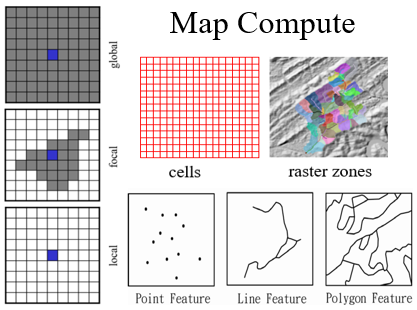
Viewed as a series of Neighborhood Relation and Graph operations.
Step 1: NbrGraph (Neighborhood relation operation)
Create a distance-based neighborhood (\(r\)).
Form a graph where points are nodes and proximity forms links.
Step 2: Graph Analysis
Identify sub-graphs (connected components).
Classify sub-graphs based on the number of points (\(m\)).
Step 3: Node Classification
Nodes in small sub-graphs (\(< m\)) are noise.
Nodes in large sub-graphs (\(\ge m\)) are core or border based on their degree (number of links).
13.10. Summary: Mapping vs. Clustering#
Mapping (KDE) results in a continuous surface (raster) showing the intensity of events.
Clustering (DBSCAN, K-Means) results in categorical assignments (attributes) for the original point features.
Choice of method depends on whether you want to visualize a “heat map” or identify distinct groups for further analysis.