

6. Local Operations#
6.1. Map Compute Framework#
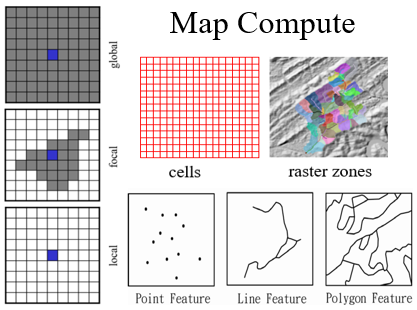
Three kinds of analysis/mapping units (MUs) in maps
Cells, raster zones, features
Four kinds of operations
Local, focal, and global operations (based on spatial scope)
Neighborhood relation operations
Mapping Units |
Neighborhood Relation: Local |
Neighborhood Relation: Focal |
Neighborhood Relation: Global |
|---|---|---|---|
Cells |
Local |
Focal |
Global |
Raster zones |
Local |
||
Features (vectors) |
Local |
6.2. Topics#
Local operations
Cells and vector features as mapping units
Output/analysis MU itself is and defines the neighborhood
Application examples
NDWI and mNDWI
Composite image
Create rainfall map using elevation map
6.3. Local Operations#
Compute a new map where the value for each MU on the output map is a function of one or more values at the same MU on the input map(s)
General form: \(Value_{new} = f(Value_{in1}, Value_{in2}, ...)\)
Output map MUs are the same as (or defined by) the input MUs
6.4. Local Operations in Practice#
Reclassify (e.g., fungus diffusion exercise)
Turn precipitation table into a map (using weather station points)
Map overlay (Intersect, Union, Erase, etc.)
Field calculator (Vector) / Raster calculator (Raster)
6.5. Types of Local Operations#
Local operations with one input map
\(Value_{new} = f(Value_{in})\)
Local operations with multiple input maps
\(Value_{new} = f(Value_{in1}, Value_{in2}, ...)\)
6.6. Local Operations: One Input Map#
Arithmetic and logical operations
\(Map + 10\)
\(Map > 100\) (Boolean output)
Reclassification
Grouping values into new categories
Example: Land cover types to “Suitable/Unsuitable”
6.7. Local Operations: Multiple Input Maps#
Cell-by-cell or feature-by-feature combination
Mathematical combinations
\(Map_A + Map_B\)
\((Map_{NIR} - Map_{Red}) / (Map_{NIR} + Map_{Red})\) (NDVI)
Overlay (Vertical Integration)
6.8. NDWI and mNDWI Example#
Normalized Difference Water Index (NDWI)
\(NDWI = (Green - NIR) / (Green + NIR)\)
Modified NDWI (mNDWI)
\(mNDWI = (Green - SWIR) / (Green + SWIR)\)
Uses local operations to enhance water features in satellite imagery
6.9. Composite Image#
Combining multiple single-band raster maps into a single multi-band map
Each band represents a different wavelength of light
A local operation where the output is a multi-valued map
6.10. Creating Rainfall Map using Elevation#
Relationship: \(Rainfall = f(Elevation)\)
If a mathematical model exists (e.g., regression: \(R = 0.5 \times Elev + 100\)), it can be applied as a local operation to the elevation map
6.11. Local Operations with Vector Features#
Calculating new attributes based on existing ones
Example: Population Density = Population / Area
Area is a geometric attribute of the MU itself
6.12. Effective Local Neighborhood#
In a local operation, the “neighborhood” is the MU itself
The operation only looks at the data within that specific unit to produce an output for that same unit
6.13. Characterizing Effective Local Neighborhood#
Sometimes the output value depends on the geometry of the MU or the distribution of features within it
Local Stats: Min, Max, Mean, Sum within the MU
Examples:
LocalSum: Sum of points within a polygon (e.g., total population in a city)
LocalCount: Number of points within a polygon (e.g., number of crimes in a district)
6.14. Summarize Data Toolset in ArcGIS#
Aggregate Points: Local operation using polygon MUs to count points within them
Summarize Within: Local operation calculating statistics for features within a boundary (polygon/rectangle)
6.15. Two Types of Local Operations Summary#
Type 1: Output MUs are the same as input MUs (Standard Map Algebra)
Type 2: Characterize effective local neighborhood where output MUs may be different from the input MUs (e.g., points to polygons)
Feature Type |
Geometry attribute |
|---|---|
Point |
Count |
Line |
Length |
Polygon |
Area, Perimeter |