

5. The Map Compute Framework#
5.1. Topics#
Overview of spatial data analysis
Overview of Map Compute Framework (MCF)
MCF vs Map Algebra (Cartographic Modelling)
5.2. Spatial Data Analysis: A Continuum of Sophistication#
Measure/Mapping
Systematically collecting geospatial data (location + attributes)
Create regular maps ({location: {attributes}})
Visualize
Present geospatial data for human interpretation and understanding
Show maps (variation in space)
Query
Maps as stored functions
Attribute, spatial and compound queries
{location: {attributes}}
Linkage between location and attributes
Predict/estimate value at a location/MU
\(a = f(l)\)
Entanglement between location and attributes (population)
5.3. Spatial Data Analysis: A Continuum of Sophistication#
Model geospatial interactional relationships and processes
Exchange of matter, energy and information in space
Create meta-maps ({location: {(location: {attributes})})
Fundamental geospatial interactional relationships
Co-locational relationship
Distance as a proxy of interactional relationship
Euclidean and non-Euclidean distance (cost distance)
Spatial auto-correlation
How attribute is self-correlated in space
First law of geography
Domain geospatial interactional relationships
Physical, biological and social processes involved in the exchange of matter, energy and information on or close to earth surface
Hydrology, ATM, etc.
5.4. Map Compute Framework (MCF)#
A comprehensive framework for analyzing geospatial data
Based on the concept of “Map as Function”
Focuses on the “Compute” part of GIS
Two components
Data model: How to represent geospatial data (MUs and attributes)
Computational model: How to manipulate and analyze geospatial data
Key elements
Mapping Units (MU)
Attributes
Spatial relationships (neighborhoods)
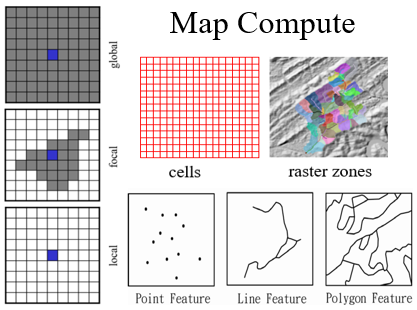
Operations (local, focal, zonal, global)
5.5. Mapping Units (MU)#
Discrete divisions of space
Used as the domain of the map function
Types of MUs
Regular: Raster cells (squares, hexagons, etc.)
Irregular: Points, lines, polygons (vector features)
Resolution and precision
Size and shape of MUs affect the quality of data and analysis
5.6. Attributes#
Qualitative or quantitative characteristics of a MU
Used as the co-domain of the map function
Levels of measurement
Nominal, ordinal, interval, ratio
Single-valued vs. multi-valued maps
5.7. Spatial Relationships (Neighborhoods)#
How MUs are related to each other in space
Used to model interactional processes
Types of neighborhoods
Immediate: Adjacent MUs (topology)
Proximity: MUs within a certain distance
Domain-specific: Watersheds, viewsheds, network connectivity
Neighborhood is a mapping: \(MU \to \{MU\}\)
5.8. Map Operations#
Mathematical or logical operations applied to maps
Classified by their spatial scope (Tomlin, 1990)
Local operations
Output value at a location depends only on the input value(s) at the same location
Focal operations
Output value depends on the input values within a neighborhood of the location
Zonal operations
Output value depends on the input values within a predefined zone
Global operations
Output value depends on the input values of the entire map
5.9. Local Operations#
\(Value_{new} = f(Value_{old})\)
Cell-by-cell or feature-by-feature processing
Examples:
Scalar math (e.g., \(map \times 2\))
Map overlay (e.g., \(map_A + map_B\))
Reclassification
5.10. Focal Operations#
\(Value_{new} = f(Values\ in\ neighborhood)\)
Also known as neighborhood operations
Requires a predefined neighborhood (kernel/window)
Examples:
Smoothing (mean), edge detection, slope, aspect
Focal flow (hydrology)
5.11. Zonal Operations#
\(Value_{new} = f(Values\ in\ zone)\)
Two input maps:
Zone map: Defines the zones
Value map: Contains the attributes to be summarized
Examples:
Average elevation per watershed
Total population per county
5.12. Global Operations#
\(Value_{new} = f(Values\ in\ entire\ map)\)
Examples:
Global mean, maximum, or minimum
Euclidean distance (from a source to all other points)
Least cost path analysis
5.13. Tomlin’s Map Algebra#
Simple but powerful approach/tools for analyzing geospatial raster data
Primary way of analyzing raster data
Implemented in commercial/open source GIS software
All the existing extensions followed the original framework
Local, focal, zonal
Remaining issues
Inconsistent structure (focal vs zonal)
Limited (enumerated) neighborhoods
Only available for raster data
5.14. Map Algebra Operations in the MC Framework#
Local operations
Cells as MUs
Focal operations
Cells as MUs
Predefined (and limited) neighborhoods
Doesn’t distinguish using and modeling geospatial interactional relationships
Zonal operations
Zones as neighborhoods (focal operations)
Zones as analysis units (local operations)
Concepts in MC but labs and tools are still using MA!
Map Compute Engine (MCE) is not entirely implemented yet
Mapping Units |
Neighborhood Relation: Local |
Neighborhood Relation: Focal |
Neighborhood Relation: Global |
|---|---|---|---|
Cells |
Local |
Focal |
Global |
Raster zones |
Zonal |
||
Features (vectors) |
5.15. Readings#
Tomlin, 2017 Cartographic modeling, The International Encyclopedia of Geography